


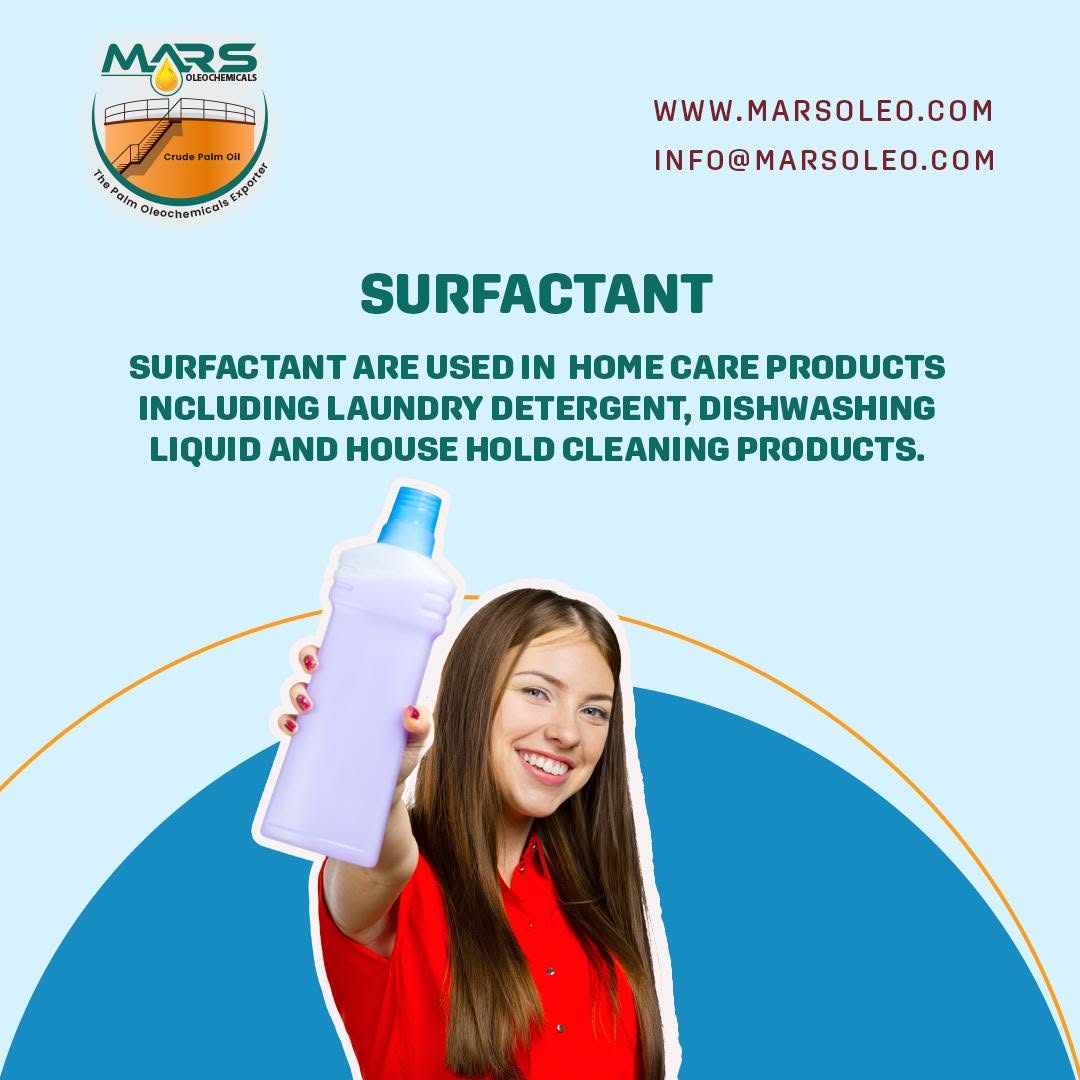
Surfactants are essential ingredients in many household cleaning formulations because they help reduce surface tension and improve interaction between water, surfaces and soils. Their surface-active behavior enables cleaning solutions to spread more effectively and helps loosen and remove oily and particulate contamination.
Laundry detergents and dishwashing liquids commonly use carefully selected surfactant systems. Anionic surfactants can provide detergency and foam, while amphoteric and nonionic surfactants may be incorporated to adjust grease removal, foam behavior, formulation stability and other performance characteristics.

Essential surface-active ingredients for cleaning, wetting, emulsification, foaming and soil removal in home-care formulations.
surfactant is ideal for every application. Laundry, dishwashing, floor care, kitchen cleaning and bathroom cleaning products can have very different requirements for foam, pH, viscosity, wetting and soil removal. Formulators therefore select surfactant combinations according to the target application.
Commercial buyers should specify the required surfactant type, active concentration, intended application, quantity, packaging and technical specification. Reviewing the relevant COA, TDS and SDS helps ensure the selected product meets the requirements of the finished home-care formulation.
What is a surfactant? A surfactant is a surface-active substance that can reduce surface or interfacial tension and support functions such as wetting, detergency, emulsification and dispersion.
Why are surfactants used in home-care products? Surfactants help cleaning solutions interact with surfaces and soils, enabling improved wetting, grease removal, detergency, emulsification and rinsing.
Are surfactants used in laundry detergents? Yes. Surfactants are major functional ingredients in many liquid and powder laundry detergent formulations.
Are surfactants used in dishwashing liquid? Yes. Dishwashing liquids commonly use surfactants to provide grease removal, wetting, detergency and suitable foam characteristics.
What is SLES 70? SLES 70 is a concentrated Sodium Laureth Sulfate grade widely used as an anionic surfactant in cleaning and personal-care formulations.
What is CAPB? CAPB stands for Cocamidopropyl Betaine, an amphoteric surfactant used in cleaning and personal-care formulations.
Are Fatty Alcohol Ethoxylates surfactants? Yes. Fatty Alcohol Ethoxylates are an important family of nonionic surfactants.
Does more foam mean better cleaning? Not necessarily. Foam profile and cleaning performance are separate formulation considerations, and some cleaning applications require low foam.
Are palm-based surfactants available? Palm and palm-kernel-derived oleochemical feedstocks can be used to manufacture Fatty Alcohols and Fatty Acids that serve as starting materials for numerous surfactants.





Home :: Products :: Enquiry :: Contact Us :: Site Map
Copyright All Rights Reserved © 2025. Mars Oleochemicals :: Disclaimer :: Privacy Policy


