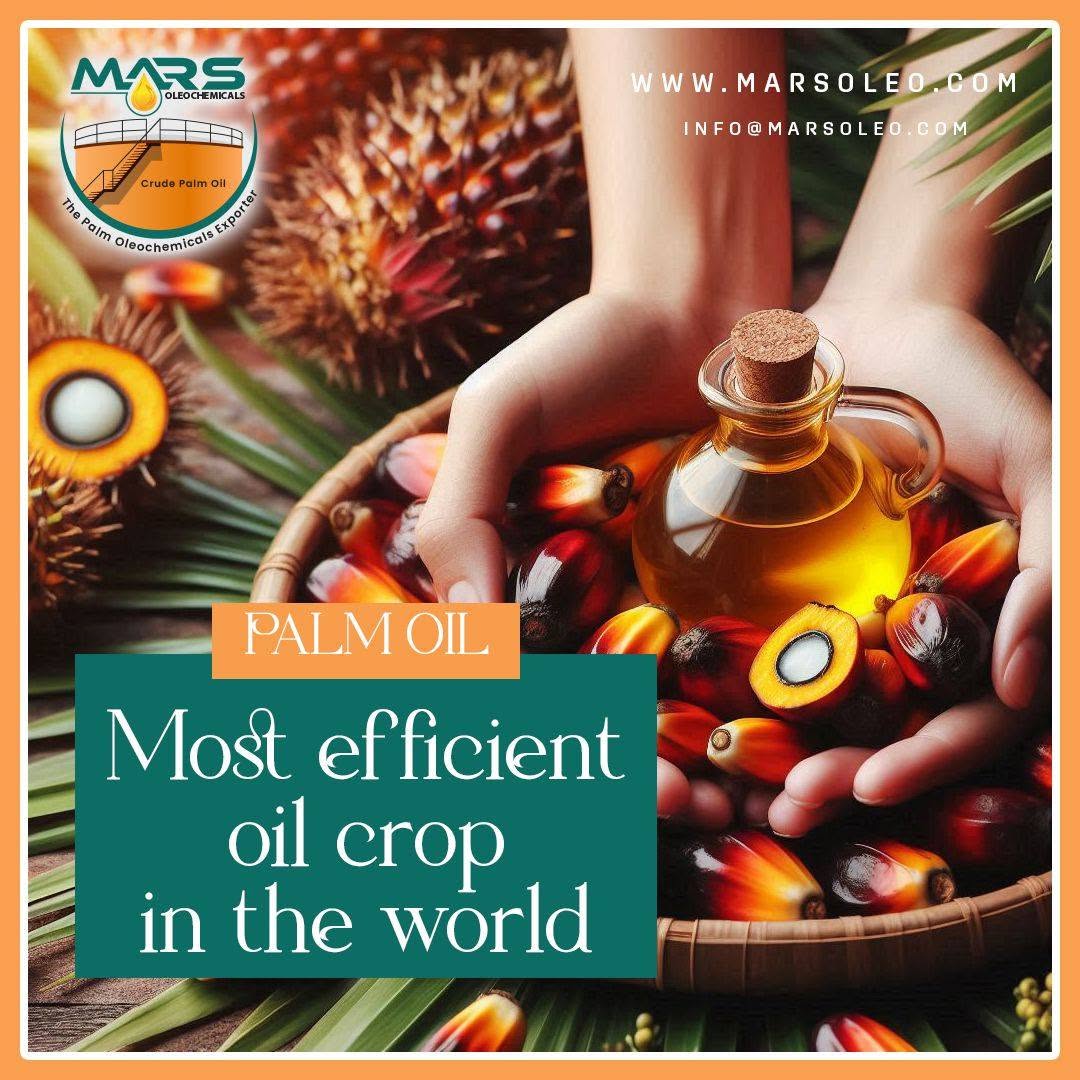
Oil palm is exceptionally productive when oil output is measured against cultivated land area. Global comparisons indicate that approximately 2.9 tonnes of palm oil can be produced from one hectare, roughly four times the oil output of sunflower or rapeseed and considerably more than coconut or groundnut. This high productivity is the strongest factual basis for describing oil palm as an efficient oil crop.
High agricultural yield allows more vegetable oil to be produced from a comparatively smaller cultivated area. Our World in Data reports that palm oil produced around 36% of global vegetable oil while occupying only 8.6% of oil-crop land in its cited 2017 comparison. This makes oil palm particularly important when evaluating global vegetable-oil supply and land productivity.

Palm Oil Delivers the Highest Oil Yield per Hectare Among Major Vegetable Oil Crops Worldwide.
Palm oil is highly versatile because it can be refined and fractionated for different applications. RBD Palm Oil is commonly used in cooking, frying, instant noodles, snack foods, margarine and shortening. Fractionation produces liquid Palm Olein, widely used as frying oil, and harder Palm Stearin, which is useful in margarine, shortening, vegetable ghee, specialty fats and soap manufacturing.
High oil yield provides a significant land-use advantage, but it should not be presented as proof that every palm-oil supply chain is automatically sustainable. Environmental performance also depends on land conversion, biodiversity protection, traceability and responsible production practices. The strongest evergreen claim is therefore “highest-yielding major vegetable oil crop per hectare,” rather than a broad claim that palm oil is universally the most sustainable crop.
Is palm oil the most efficient oil crop in the world? Oil palm is more precisely described as the highest-yielding major vegetable oil crop per hectare because it produces substantially more oil per cultivated area than other major oil crops.
How much palm oil can be produced per hectare? Global comparisons indicate that approximately 2.9 tonnes of palm oil can be produced per hectare, although actual yields vary according to location, climate, planting material and plantation management.
Why is oil palm considered land efficient? Oil palm produces considerably more vegetable oil from each hectare of cultivated land than major alternatives such as sunflower, rapeseed, coconut and groundnut.
Does high oil yield automatically make palm oil sustainable? No. High yield provides strong land-use efficiency, but sustainability also depends on plantation location, biodiversity protection, responsible land management, traceability and environmental and social practices.
Where does palm oil come from? Palm oil is extracted from the fleshy mesocarp of oil palm fruit, while palm kernel oil is a separate oil obtained from the kernel inside the fruit. Mars also identifies palm oil as an edible vegetable oil extracted from the mesocarp of oil palm fruit.
What is palm oil used for? Palm oil and its fractions are used in cooking, frying, instant noodles, bakery products, margarine, shortening, confectionery, soaps, personal-care products and oleochemical manufacturing.
What are RBD Palm Oil, Palm Olein and Palm Stearin? RBD Palm Oil is refined, bleached and deodorized palm oil. Fractionation separates it into liquid Palm Olein and harder Palm Stearin for different food and industrial applications.
Where can buyers source Malaysian palm oil? International buyers can contact Mars Oleochemicals Sdn. Bhd. for palm oil specifications, packing options, technical documentation, current availability and export quotations. Mars currently publishes RBD Palm Oil and a broad portfolio of palm-oil fractions for international commercial applications.







Home :: Products :: Enquiry :: Contact Us :: Site Map
Copyright All Rights Reserved © 2025. Mars Oleochemicals :: Disclaimer :: Privacy Policy