| Commercial Name | Cocodiethanolamide - CDEA |
|---|---|
| Product Name | Cocamide DEA |
| Group of Chemicals | Fatty Alcohol Amide |
| Common Name | Cocamide DEA, Coconut Fatty Acid Diethanolamide -CDE 85, Cocodiethanolamide CDE 85, Coconut Diethanolamide, CDEA, Palm Kernelamide |
| CAS Number | 68155-07-7 / 73807-15-5 |
| EC Number | 277-612-1 |
| H.S Code | 3402.42.9000 |
| Cocodiethanolamide - CDEA-85 - Specification | Cocodiethanolamide - CDEA-85 - Specification |
| SDS - Safety Data Sheet | Cocodiethanolamide - CDEA-85 - Safety Data Sheet (SDS) - MSDS |
| TDS - Technical Data Sheet | Cocodiethanolamide - CDEA-85 - Technical Data Sheet - TDS |
| COA - Certificate of Analysis | Cocodiethanolamide - CDEA-85 - Certificate of Analysis - COA |
| Application of substance | Dispersing agent, Emulsifier, Foam booster, Thickening agent, Wetting agent Shampoo, Shower gel, Liquid detergent, Home and Personal Care |
| Details of the Manufacturer/Supplier | Mars Oleochemicals Sdn Bhd® |
| Kuala Lumpur, Malaysia | |
| Contact Person | Safety and Health Manager - Officer / Quality Control Manager - Chemist |
| info@marsoleo.com | |
| Telephone | +60 3 21175031 |
| Classification of substance or mixture |
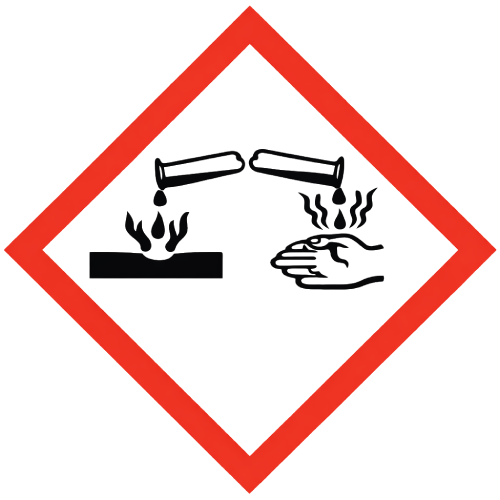 Corrosion Corrosion
|
| Eye Dam. 1 | H318 Causes serious eye damage. |
| Skin Contact |

|
| Skin Irrit. 2 | H315 Causes skin irritation. |
| Label Elements | |
|---|---|
| GHS label elements | The substance is classified and labelled according to the Globally Harmonized System (GHS). |
| Hazard pictograms |
GHS05
|
| Signal word | Danger |
| Hazard-determining components of labelling | Amides, C8-18 (even numbered) and C18-unsatd., N,N-bis(hydroxyethyl) |
| Hazard statements | Causes skin irritation. Causes serious eye damage. |
| Precautionary Statements | |
| Wear eye protection / face protection. | |
| IF ON SKIN | Rinse cautiously with water for several minutes. Remove contact lenses, if present and easy to do. Continue rinsing. |
| Immediately call a POISON CENTER/doctor. | |
| Specific treatment (see on this label). | |
| Take off contaminated clothing and wash it before reuse. If skin irritation occurs: Get medical advice/attention. | |
| Other hazards Results of PBT and vPvB assessment | |
| Results of PBT assessment | This product is not classified as PBT. |
| Results of vPvB assessment | This product is not classified as vPvB. |
| Chemical Characterization : Substances | |
|---|---|
| CAS No. Description | 68155-07-7 Amides, C8-18 (even numbered) and C18-unsatd., N,N-bis(hydroxyethyl) / 73807-15-5 Amides, palm kernel-oil, N,N-bis(hydroxyethyl) |
| Dangerous components | 287-809-4 |
| EC number | |
| H.S Code | 3823.19.2000 |
| Dangerous components | ||
|---|---|---|
| 68155-07-7 | Amides, C8-18 (even numbered) and C18-unsatd., N,N-bis(hydroxyethyl) Eye Dam. 1, H318; Skin Irrit. 2, H315; | > 80% |
| 111-42-2 | 2,2'-iminodiethanol STOT RE 2, H373; Eye Dam. 1, H318; Acute Tox. 4, H302; Skin Irrit. 2, H315 | 1 - 5% |
| Additional information | For the wording of the listed hazard phrases refer to section 16. | |
| General Information | Immediately remove any clothing soiled by the product. In case of adverse health effects seek medical advice. |
|---|---|
| After Inhalation | In case of unconsciousness place patient stably in side position for transportation. |
| After Skin contact | If skin irritation continues, consult a doctor. Immediately wash with water and soap and rinse thoroughly. |
| After Eye contact | Rinse opened eye for several minutes under running water. Then consult a doctor. |
| After Swallowing | Rinse out mouth and then drink plenty of water. Call a doctor immediately. |
| Information for Doctor | |
| Most important symptoms and effects, both acute and delayed | Breathing difficulty, Coughing, Dizziness, Headache |
| Indication of any immediate medical attention needed | No further relevant information available. |
| Extinguishing Media | |
|---|---|
| Suitable Extinguishing agents | CO2, sand, extinguishing powder. Do not use water. Sand |
| For safety reasons unsuitable extinguishing agents | Water with full jet. Water |
| Special hazards arising from the substance or mixture | In case of fire, the following can be released: Nitrogen oxides (NOx) , Carbon monoxide (CO) |
| Advice for firefighters | Protective clothing and self-contained breathing equipment should be carried Avoid breathing dust / fume / gas / mist / vapours / spray. |
| Protective equipment | Wear self-contained respiratory protective device. Wear fully protective suit. |
| Personal precautions, protective equipment and emergency procedures | Wear protective clothing. Use gloves, face shield, Keep unprotected persons away. Use respiratory protective device against the effects of fumes / dust / aerosol. |
| Environmental Precautions | Do not allow product to reach sewage system or any water course. Inform respective authorities in case of seepage into water course or sewage system. Dilute with plenty of water. Do not allow to enter sewers / surface or ground water. |
| Methods and material for containment and cleaning up | Absorb with liquid-binding material (sand, diatomite, acid binders, universal binders, sawdust). Dispose contaminated material as waste according to section 13. |
| Reference to other sections |
See Section 7 for information on safe handling. |
| Precautions for safe handling | Keep receptacles tightly sealed and away from heat and direct sunlight. Ensure good ventilation/exhaustion at the workplace. Use gloves and wear goggles when handling. Use appropriate industrial vacuum cleaners or central vacuum systems for dust removal. To avoid fire or explosion, dissipate static electricity during transfer by grounding and bonding containers and equipment before transferring material. |
| Information about fire - and explosion protection | Keep ignition sources away - Do not smoke. Keep respiratory protective device available. |
| Conditions for safe storage | Store in the original closed containers. Keep in a cool and dry place, avoid extreme heat and cold. |
| Requirements to be met by storerooms and receptacles | Store only in the original receptacle |
| Information about storage in one common storage facility | Store away from oxidizing agents. |
| Further information about storage conditions | Keep container tightly sealed. Protect from heat and direct sunlight. Store in cool, dry conditions in well-sealed at ambient temperature. |
| Specific end use(s) | No further relevant information available. |
| Additional information about design of technical facilities | No further data; see item 7. | |
| Control Parameters | ||
|---|---|---|
| Ingredients with limit values that require monitoring at the workplace | Not required. | |
| Exposure Controls | ||
| Protection of hands | Protective Gloves : The glove material has to be impermeable and resistant to the product/ the substance/ the preparation. Selection of the glove material on consideration of the penetration times, rates of diffusion and the degradation | |
| Material of Gloves : The selection of the suitable gloves does not only depend on the material, but also on further marks of quality and varies from manufacturer to manufacturer. |

|
|
| Penetration time of glove Material : The exact break through time has to be found out by the manufacturer of the protective gloves and has to be observed. | ||
| Eye protection | Tightly sealed Safety goggles |

|
| Parameter | Value |
|---|---|
| Chemical Name | CDEA 85 |
| Appearance: Form | |
| Form | Liquid, Viscous |
| Colour | Clear, Yellowish |
| Odour | Light |
| Odour threshold | Not determined |
| pH (2% aq. solution) | 9 - 11 (EM QCA 045) |
| Change in Condition | |
| Melting point/freezing point | > -10 - < -7 °C (ASTM D87-87) |
| Initial boiling point and boiling range | Undetermined |
| Parameter | Value |
| Flash point | 188 °C (ASTM D6450-99) |
| Flammability (solid, gas) | Not applicable |
| Decomposition temperature | Not Determined |
| Explosive Properties | Product does not present an explosion hazard |
| Lower Explosion Limit | Not Determined |
| Upper Explosion Limit | Not Determined |
| Vapour Pressure | Not determined. |
| Vapour pressure at 20 °C | 0 Pa (OECD 104) |
| Density | Not determined |
| Relative density at 20 °C | 0.958 mg/L (OECD 109) |
| Vapour density | Not determined |
| Evaporation rate | Not determined |
| Solubility in / Miscibility with water at 20 °C | 15 mg/L (QSAR) |
| Partition coefficient: n-octanol/water | 3.75 Log Pow (OECD 117) |
| Viscosity | |
| Dynamic at 20 °C | 1,357 mPas (OECD 114) |
| Other information | No further relevant information available |
| Reactivity | No further relevant information available. |
| Chemical stability | Stable at environment temperature. |
| Thermal decomposition / conditions to be avoided | No decomposition if used according to specifications. |
| Possibility of hazardous reactions | No dangerous reactions known |
| Conditions to avoid | See Section 7 for information of safe handling. |
| Incompatible materials | See Section 7 for information of safe handling |
| Hazardous decomposition products | Carbon monoxide and carbon dioxide |
| Information on Toxicological Effects | |||
|---|---|---|---|
| Acute Toxicity | |||
| LD/LC50 values relevant for classification 68155-07-7 Amides, C8-18 (even numbered) and C18-unsatd., N,N-bis(hydroxyethyl) | Oral | LD50 | >2,000 mg/kg bw (Rat, Sprague-Dawley) (OECD 401) |
| Dermal | LD50 | >2,000 mg/kg bw (Rabbit) (Standard acute method) | |
| Conclusion / Summary | No adverse effect observed. | ||
| Primary irritant effect | |||
| Skin corrosion / irritation | irritant effect | ||
| 68155-07-7 Amides, C8-18 (even numbered) and C18-unsatd., N,N-bis(hydroxyethyl) | Irritation of skin > Irritation/Corrosion > 3 - < 4 score (Rabbit) (Skin - Patch test, OECD 404) | ||
| Serious eye damage / irritation | Strong irritant with the danger of severe eye injury. | ||
| 68155-07-7 Amides, C8-18 (even numbered) and C18-unsatd., N,N-bis(hydroxyethyl) | Irritation of eyes > Irritation / Corrosion score (Rabbit) (Not fully reversible within: 21 days, OECD 405) | ||
| Respiratory or skin sensitization | Not sensitizing | ||
| 68155-07-7 Amides, C8-18 (even numbered) and C18-unsatd., N,N-bis(hydroxyethyl) | Sensitisation - Respiratory / skin sensitization: 0 SI value (Guinea pig) (OECD 406, In vivo, non-LLNA) | ||
| Additional Toxicological information | |||
| Repeated dose toxicity 68155-07-7 Amides, C8-18 (even numbered) and C18-unsatd., N,N-bis(hydroxyethyl) | Oral - NOAEL (short-term) > 750 mg/kg bw/day (Rat) (OECD 407) | ||
| CMR Effects (Carcinogenicity, mutagenicity and toxicity for reproduction) | |||
| Germ cell mutagenicity | No mutagenic effect. | ||
| 68155-07-7 Amides, C8-18 (even numbered) and C18-unsatd., N,N-bis(hydroxyethyl) | Mutagenicity - Negative (Mouse Lymphoma L5178Y Cells) (Mammalian cell gene mutation assay) | ||
| Carcinogenicity | No data available | ||
| Reproductive toxicit | Based on available data, the classification criteria are not met. | ||
| 68155-07-7 Amides, C8-18 (even numbered) and C18-unsatd., N,N-bis(hydroxyethyl) | NOAEL (dev/fert/repro) | 1,000 mg/kg bw/day (Rat, Sprague-Dawley) (OECD 422) | |
| NOAEL (embr/tera) | 1,000 mg/kg bw/day (Rat, Sprague-Dawley) (OECD 414) | ||
| Toxicity | |
|---|---|
| Aquatic toxicity | No adverse effect observed |
| 68155-07-7 Amides, C8-18 (even numbered) and C18-unsatd., N,N-bis(hydroxyethyl) | |
| Chronic LC50 (24h) | 13.8 mg/L (Fish, Oryzias latipes) (Danish EPA (2001)) |
| Chronic NOEC (24h) | 2.8 mg/L (Aquatic invertebrates,Daphnia magna) (Danish EPA (2001)) |
| Persistence and degradability | Readily biodegradable |
| Passed 10-day window | Yes |
| 68155-07-7 Amides, C8-18 (even numbered) and C18-unsatd., N,N-bis(hydroxyethyl) | |
| Biodegradation in water | 92.5 % within 28 days (20 mg/L, OECD 301 B) |
| Behavior in environmental systems: | |
| Bioaccumulative potential | Does not accumulate in organisms |
| Mobility in soil | No further relevant information available. |
| Additional Ecological information | |
| General notes | Water hazard class 2 (German Regulation) : hazardous for water Do not allow undiluted product or large quantities of it to reach ground water, water course or sewage system. Must not reach sewage water or drainage ditch undiluted or unneutralised. |
| Results of PBT and vPvB assessment | PBT: This product is not classified as PBT. |
| vPvB: This product is not classified as vPvB. | |
| Other adverse effects | No further relevant information available |
| Waste treatment methods | Waste incineration with the approval of the responsible local authority |
| Recommendation | Must not be disposed together with household garbage. Do not allow product to reach sewage system. Must be specially treated adhering to official regulations. |
| Uncleaned packaging: Recommendation | Disposal must be made according to official regulations |
| UN-Number | Not Regulated |
| ADR/RID/ADN, IMDG, IATA | |
| UN proper shipping name | Not Regulated |
| ADR/RID/ADN, IMDG, IATA | |
| Transport Hazard Class(es) | |
|---|---|
| ADR/RID/ADN, ADN, IMDG, IATA | Not Regulated |
| Class | |
| Packing Group | |
| ADR/RID/ADN, IMDG, IATA | Not Regulated |
| Environmental Hazards | |
| Environmental hazards | No |
| Special precautions for user | Not applicable |
| Transport in bulk according to Annex II of Marpol and the IBC Code | Not applicable |
| UN "Model Regulation" | Not Regulated |
| Safety, health and environmental regulations/legislation specific for the substance or mixture | |
| TSCA (Toxic Substances Control Act) | All ingredients are listed |
| 68155-07-7 Amides, C8-18 (even numbered) and C18-unsatd., N,N-bis(hydroxyethyl) ACTIVE 73807-15-5 Amides, palm kernel-oil, N,N-bis(hydroxyethyl) ACTIVE 111-42-2 2,2'-iminodiethanol ACTIVE | |
| Canadian Domestic Substances List (DSL) | All ingredients are listed. |
| 68155-07-7 Amides, C8-18 (even numbered) and C18-unsatd., N,N-bis(hydroxyethyl) 73807-15-5 Amides, palm kernel-oil, N,N-bis(hydroxyethyl) 111-42-2 2,2'-iminodiethanol | |
| Philippines Inventory of Chemicals and Chemical Substances | Substance is listed |
| 73807-15-5 Amides, palm kernel-oil, N,N-bis(hydroxyethyl) 111-42-2 2,2'-iminodiethanol | |
| Chinese Chemical Inventory of Existing Chemical Substances | Substance is listed |
| 68155-07-7 Amides, C8-18 (even numbered) and C18-unsatd., N,N-bis(hydroxyethyl) 73807-15-5 Amides, palm kernel-oil, N,N-bis(hydroxyethyl) 111-42-2 2,2'-iminodiethanol | |
| Australian Inventory of Industrial Chemicals | Substance is listed. |
| 68155-07-7 Amides, C8-18 (even numbered) and C18-unsatd., N,N-bis(hydroxyethyl) 111-42-2 2,2'-iminodiethanol | |
| ECHA EC Inventory Database | EINECS No.: 277-612-1 |
| 68155-07-7 Amides, C8-18 (even numbered) and C18-unsatd., N,N-bis(hydroxyethyl) KE-01069 111-42-2 2,2'-iminodiethanol KE-20959 | |
| New Zealand Inventory of Chemicals | All ingredients are listed |
| 111-42-2 2,2'-iminodiethanol | |
| Existing Chemical Directory of Thailand (DIW) | All ingredients are listed |
| 68155-07-7 Amides, C8-18 (even numbered) and C18-unsatd., N,N-bis(hydroxyethyl) 73807-15-5 Amides, palm kernel-oil, N,N-bis(hydroxyethyl) 111-42-2 2,2'-iminodiethanol | |
| TCSI - Taiwan Chemical Substance Inventory | All ingredients are listed |
| 68155-07-7 Amides, C8-18 (even numbered) and C18-unsatd., N,N-bis(hydroxyethyl) 73807-15-5 Amides, palm kernel-oil, N,N-bis(hydroxyethyl) 111-42-2 2,2'-iminodiethanol | |
| Malaysia - EHS reference list | All ingredients are listed |
| 111-42-2 2,2'-iminodiethanol | |
| 68155-07-7 Amides, C8-18 (even numbered) and C18-unsatd., N,N-bis(hydroxyethyl) 73807-15-5 Amides, palm kernel-oil, N,N-bis(hydroxyethyl) 111-42-2 2,2'-iminodiethanol | |
| Vietnam - National Existing Chemical Inventory | All ingredients are listed |
| 68155-07-7 Amides, C8-18 (even numbered) and C18-unsatd., N,N-bis(hydroxyethyl) 73807-15-5 Amides, palm kernel-oil, N,N-bis(hydroxyethyl) 111-42-2 2,2'-iminodiethanol | |
| Safety, health and environmental regulations/legislation specific for the substance or mixture | |
| GHS label elements | The substance is classified and labelled according to the Globally Harmonised System (GHS) |
| Hazard pictograms |
GHS05
|
| Signal word | Danger |
| Hazard-determining components of labelling | Amides, C8-18 (even numbered) and C18-unsatd., N,N-bis(hydroxyethyl) |
| Hazard statements | Harmful if swallowed. Causes skin irritation. Causes serious eye damage. |
| Precautionary statements | |
|---|---|
| Wear eye protection / face protection. | |
| IF IN EYES | Rinse cautiously with water for several minutes. Remove contact lenses, if present and easy to do. Continue rinsing. |
| Immediately call a Poison Center / doctor. | |
| Specific treatment (see on this label). | |
| Take off contaminated clothing and wash it before reuse. | |
| If skin irritation occurs: Get medical advice/attention. | |
| Directive 2012/18/EU | Substance is not listed. |
| Named dangerous substances - ANNEX I | |
| National regulations | WGK Identification No. 8799 for Amides, C8-18 and C18-unsatd., N,N-bis(hydroxyethyl) |
| Waterhazard class | |
| Chemical safety assessment | A Chemical Safety Assessment has been carried out |
| This information is based on our present knowledge. However, this shall not constitute a guarantee for any specific product features and shall not establish a legally valid contractual relationship. | |
| Department issuing SDS | Product Safety & Regulations Department |
| Contact: Product Safety & Regulations Info@Marsoleo.com | |
| Abbreviations and Acronyms | |
|---|---|
| RA | Read-across |
| LLNA | Local Lymph Node Assay |
| NOAEL | No Observed Adverse Effect Level |
| NOEC | No Observed Effect Concentration |
| SCE | Sister Chromatid Exchange |
| OECD | Organisation for Economic Co-operation and Development |
| DNEL | Derived No-Effect Level |
| PNEC | Predicted No-Effect Concentration |
| STP | Sewage Treatment Plant |
| ADG | The Australian Code for the Transport of Dangerous Goods by Road & Rail |
| LoS | Limit of Solubility |
| SCL | Specific Concentration Limit |
| LOEC | Lowest Observed Effect Concentration |
| SSWL | Skin Surface Water Loss |
| IMDG | International Maritime Code for Dangerous Goods |
| IATA | International Air Transport Association |
| EINECS | European Inventory of Existing Commercial Chemical Substances |
| CAS | Chemical Abstracts Service (division of the American Chemical Society) |
| LC50 | Lethal concentration, 50 percent |
| LD50 | Lethal dose, 50 percent |
| PBT | Persistent, Bioaccumulative and Toxic |
| vPvB | very Persistent and very Bioaccumulative |
| Skin Irrit. 2 | Skin corrosion/irritation - Category 2 |
| Eye Dam. 1 | Serious eye damage/eye irritation - Category 1 |
| Aquatic Chronic 3 | Hazardous to the aquatic environment - long-term aquatic hazard - Category 3 |
| Sources |
|---|
| Annex 12 of Resolution MEPC.225(64) 2012 Amendments to The International Code For The Construction and Equipment of Ships Carrying Dangerous Chemicals in Bulk (IBC Code). |
| Danish EPA (2001). Environmental Project No. 615. Environmental and Health Assessment of Substances in Household Detergents and Cosmetic Detergent Products |
| ECHA Registered Subtances Database, CAS No. 68155-07-7 (List No. 931-329-6) |
| Globally Harmonized System of Classification and Labelling of Chemicals (GHS), Third Revised Edition. |
| ICOP (2014). The Industry Code of Practice on Chemical Classification and Hazard Communication. |
| ICOP (2019). The Industry Code of Practice on Chemical Classification and Hazard Communication (Amendment). |
| IMO (2020). IMDG Code International Maritime Dangerous Goods Code. Incorporating Amendment 40-20. |
| Official Journal of the European Union Commission Regulation (EU) No 453/2010. |
| Official Journal of the European Union Commission Regulation (EU) 2015/830. |
| Official Journal of the European Union Commission Regulation (EU) 2020/878. |
| Official Journal of the European Union Regulation (EC) No 1272/2008. |
| Official Journal of the European Union Regulation (EC) No 1907/2006. |
| P.U. (A) 310/2013. Occupational Safety Health (Classification, Labelling and Safety Data Sheet of Hazardous Chemicals) Regulations. |
| Data Compared to the Previous Version Altered. |
|
MARS OLEOCHEMICALS® Revision 1 (Mar 31, 2023) New issuance of GHS SDS according to ChemGes. Revision 2 (January 01, 2024) |
| Section 1 - Update product description name COCODIETHANOLAMIDE-CDE according Technical Data Sheet (TDS). |
| Department issuing SDS: Product Safety & Regulations Department |
| Contact: Product Safety & Regulations Info@Marsoleo.com |

Home :: Products :: Enquiry :: Contact Us :: Site Map
Copyright All Rights Reserved © 2025. Mars Oleochemicals :: Disclaimer :: Privacy Policy